I-131 vs I-123 for Post-Thyroidectomy Whole-Body Scans
CC BY-SA 3.0 · Wikimedia Commons · source file
Question
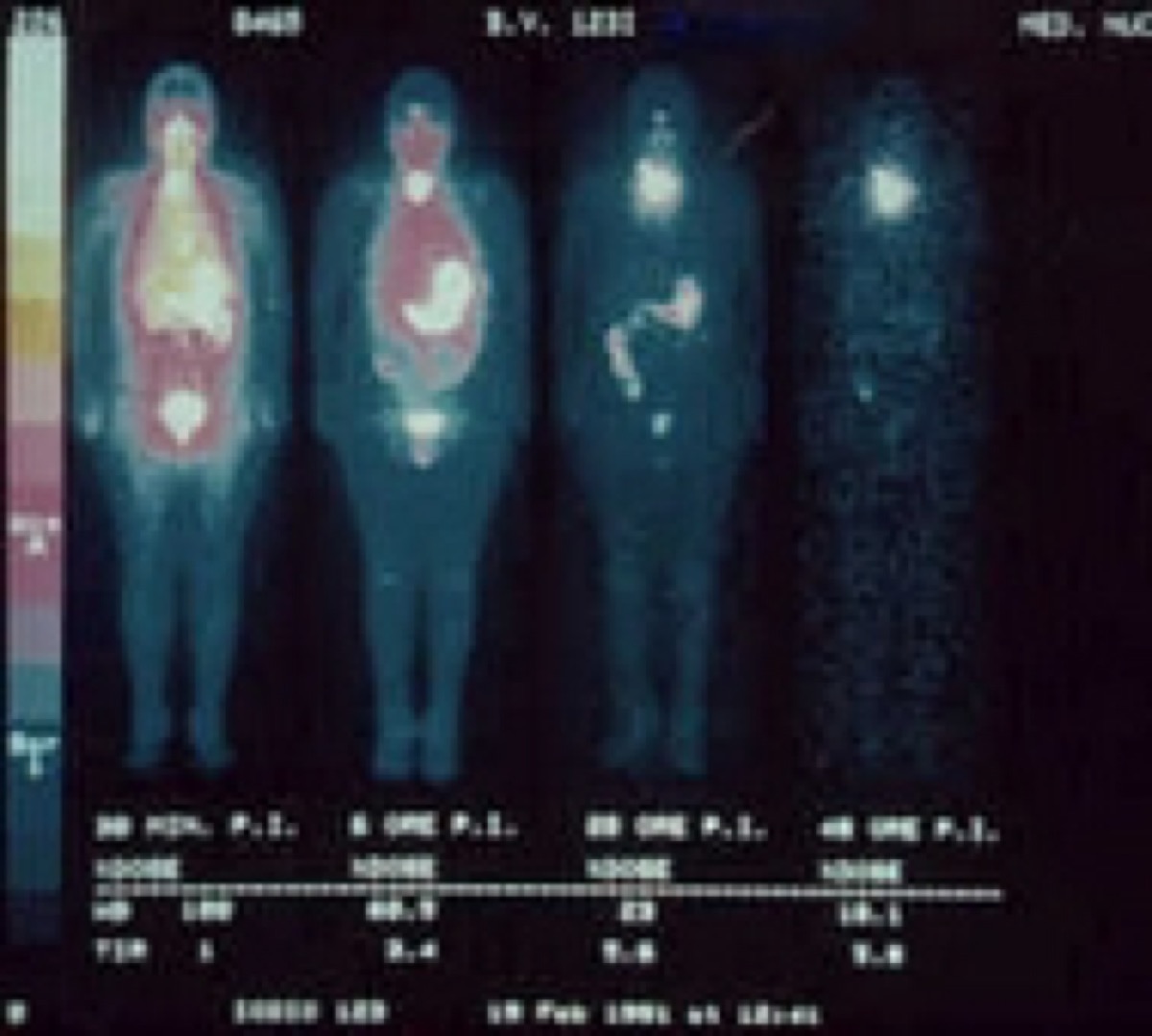
After thyroid cancer surgery (total thyroidectomy) and radioiodine ablation with I-131, a diagnostic whole body scan is performed to detect residual or metastatic thyroid tissue. In this context, I-131 is preferred over I-123 because:
- AI-131 has better image quality due to higher photon energy
- BI-131 does not require thyroid hormone withdrawal
- CI-131's longer half-life (8 days) allows delayed imaging at 5-7 days to detect metastases
- DI-131 is not taken up by normal tissue, reducing background activity
Show the answer and explanation
C. I-131's longer half-life (8 days) allows delayed imaging at 5-7 days to detect metastases
For post-therapy or diagnostic whole body scanning in differentiated thyroid cancer, I-131 is commonly used because its 8-day half-life permits delayed imaging at 3–7 days after administration. This delay allows normal background activity to clear, improving detection of residual thyroid tissue and distant metastases. I-123 (13.2-hour half-life) can only be imaged at 24 hours, limiting delayed scan capability. Thyroid hormone withdrawal or recombinant TSH stimulation (Thyrogen) is required with EITHER isotope to elevate TSH and stimulate iodine uptake.
More thyroid and parathyroid images
 Cold Thyroid Nodule: The Next Step
Lingual Thyroid on I-123 Scan
I-131 Dose Calculation for Graves’ Disease
Normal Radioactive Iodine Uptake (RAIU) Range
 Thyroglobulin Monitoring After Thyroid Cancer Ablation
Thyroid Stunning After Diagnostic I-131
All 130 nuclear medicine images by category →
Practise image interpretation in the app
All 130 images as an interactive quiz, alongside 500 NMTCB and ARRT(N) questions with worked explanations, case studies and timed mock exams. 25 questions are free, no card and no account.