Why I-123 Is Used for Diagnostic Thyroid Imaging
CC BY-SA 3.0 · Wikimedia Commons · source file
Question
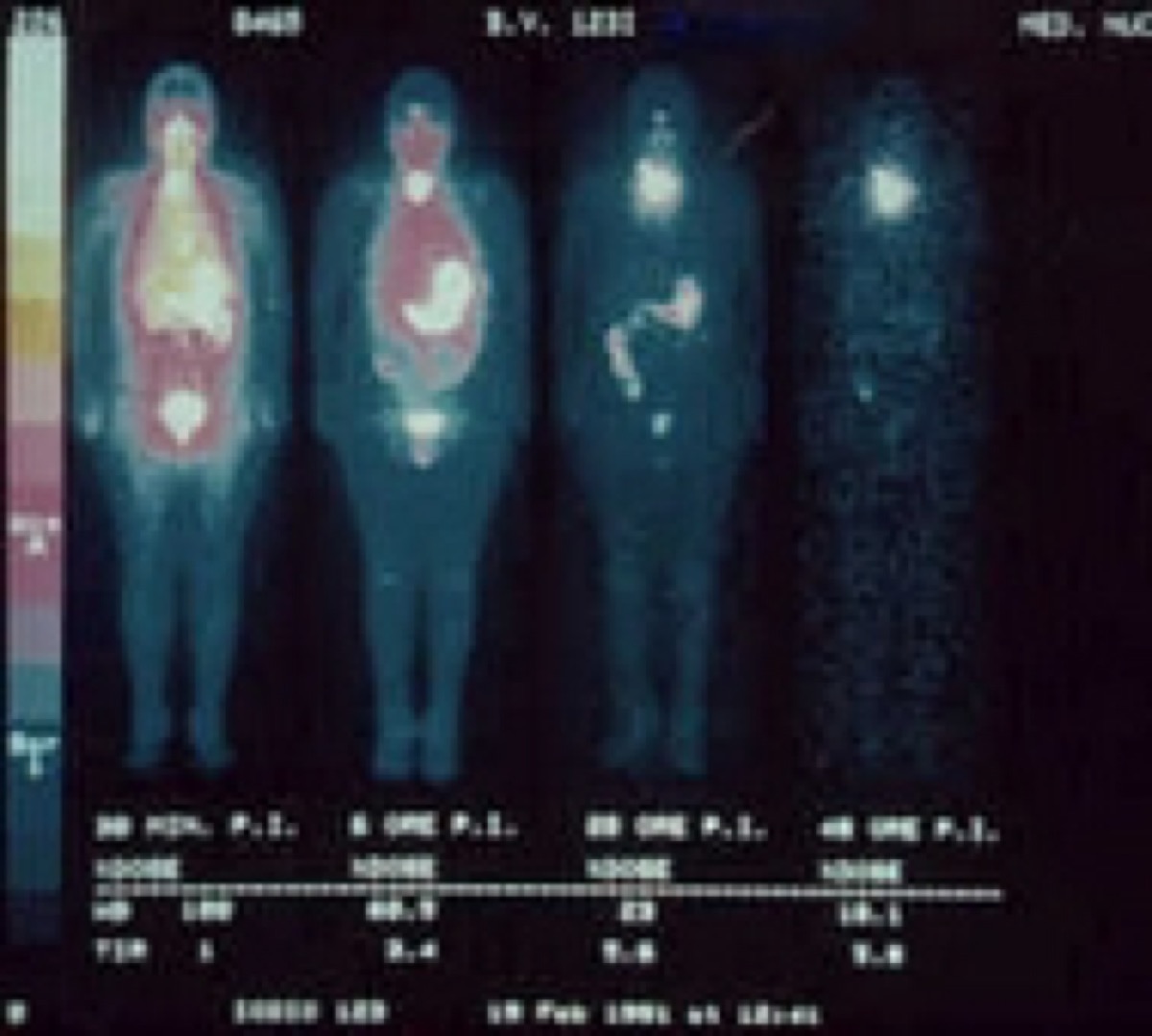
This series of I-123 total body scans demonstrates normal biodistribution of radioiodine over time. Why is I-123 preferred over I-131 for DIAGNOSTIC thyroid imaging?
- AI-123 has a longer physical half-life than I-131, allowing imaging sessions to be spread over several days
- BI-123 emits energetic beta particles in addition to gamma rays, which improves gamma camera detection efficiency
- CI-123 distributes uniformly to all body tissues rather than concentrating selectively in the thyroid, reducing background noise
- DI-123 emits only gamma radiation with a 13.2-hour half-life, delivering a much lower radiation dose than I-131
Show the answer and explanation
D. I-123 emits only gamma radiation with a 13.2-hour half-life, delivering a much lower radiation dose than I-131
I-123 is preferred for diagnostic thyroid imaging because: (1) its half-life is 13.2 hours — long enough for imaging but short enough for rapid patient clearance; (2) it emits only gamma radiation (159 keV) with no beta particles, resulting in minimal absorbed dose to the thyroid. I-131 (half-life 8.02 days, emits both beta and gamma) delivers significant thyroid dose — acceptable for therapy but undesirable for diagnostics. I-131 is still used for post-ablation scanning in thyroid cancer, where its longer half-life aids in detecting distant metastases.
More thyroid and parathyroid images
I-131 vs I-123 for Post-Thyroidectomy Whole-Body Scans
 Cold Thyroid Nodule: The Next Step
Lingual Thyroid on I-123 Scan
I-131 Dose Calculation for Graves’ Disease
Normal Radioactive Iodine Uptake (RAIU) Range
 Thyroglobulin Monitoring After Thyroid Cancer Ablation
All 130 nuclear medicine images by category →
Practise image interpretation in the app
All 130 images as an interactive quiz, alongside 500 NMTCB and ARRT(N) questions with worked explanations, case studies and timed mock exams. 25 questions are free, no card and no account.