F-18 Half-Life and Decay Mode
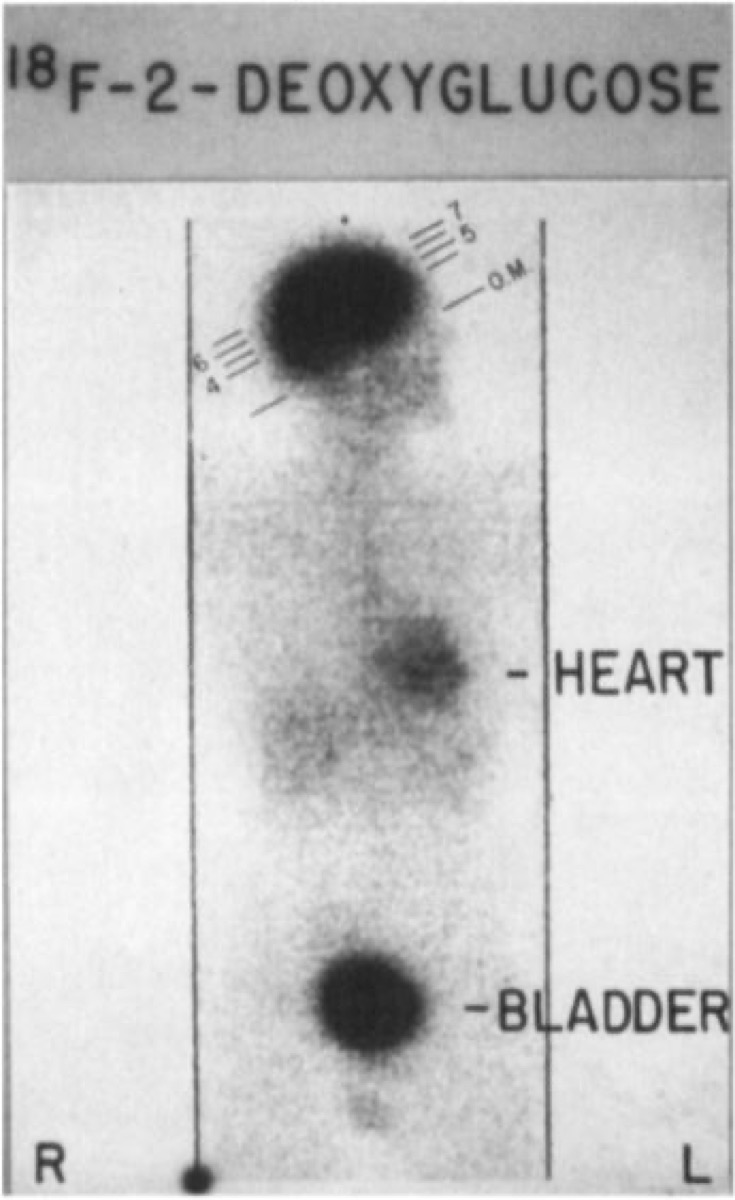
CC BY-SA 4.0 · Pennradiology / Wikimedia Commons · source file
Question
F-18 (fluorine-18) is the most widely used PET radionuclide. What is its physical half-life and primary mode of production?
- APhysical half-life 110 minutes; produced by a cyclotron via proton bombardment of O-18 enriched water
- BPhysical half-life 75 seconds; produced from a strontium-82 generator
- CPhysical half-life 68 minutes; produced from a germanium-68 generator
- DPhysical half-life 10 minutes; produced by a cyclotron from N-14
Show the answer and explanation
A. Physical half-life 110 minutes; produced by a cyclotron via proton bombardment of O-18 enriched water
F-18 has a physical half-life of 109.77 minutes (~110 minutes). It decays by positron emission (97%) to O-18. F-18 is produced by cyclotron via proton bombardment of O-18-enriched water: ¹⁸O(p,n)¹⁸F. The 110-minute half-life is long enough to allow off-site production and regional distribution (unlike N-13 at 10 min or Rb-82 at 75 sec, which require on-site production), yet short enough for reasonable patient radiation dose and efficient department scheduling. F-18 FDG (fluorodeoxyglucose) is produced by nucleophilic substitution of a precursor molecule with F-18 in an automated synthesis module.
More pet and oncology images
PET Coincidence Detection of 511 keV Photons
 MIBG Scan for Neuroblastoma Staging
 Lu-177 DOTATATE Therapy for Neuroendocrine Tumors
Paraganglioma: Ga-68 DOTATATE PET vs MIBG
Medications to Stop Before an MIBG Scan
Carcinoid Tumor on Somatostatin Receptor Imaging
All 130 nuclear medicine images by category →
Practise image interpretation in the app
All 130 images as an interactive quiz, alongside 500 NMTCB and ARRT(N) questions with worked explanations, case studies and timed mock exams. 25 questions are free, no card and no account.